How Bees Communicate Food Locations
In the darkness of a hive, far from the sunlight and blossoms their foraging sisters visit, honey bees perform a remarkable and elegant ballet. This is not mere ritual — it is an encoded message, a language of movement built over millions of years of evolution. Known as the waggle dance, it allows a forager bee to convey to her nestmates not only that food is available, but precisely where it lies.
The waggle dance is one of nature’s most fascinating communication systems. It encodes both direction and distance toward a resource (nectar, pollen, water, or resin) and even signals the quality of that resource. Over time, scientific research has peeled back layer after layer of complexity—from how the dance is shaped by sunlight and landmarks, to how followers decode it neurologically, to how social learning refines the process. This article walks through the science behind the waggle dance, what is still unknown, and how recent experiments are expanding our understanding.
The Basics: How Does the Waggle Dance Work?
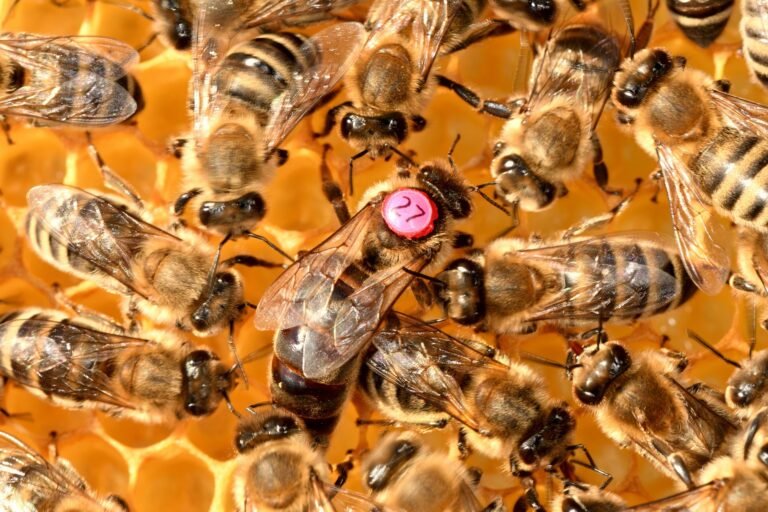
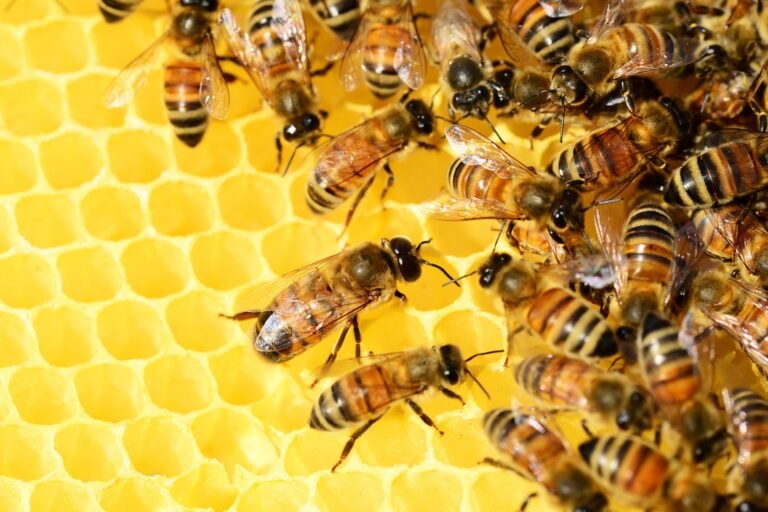
When a forager bee returns to the hive with a profitable food source, she may perform a dance on the vertical surface of the comb. The dance consists of a waggle run and return phases, arranged in a figure-eight pattern. During the waggle run, the bee moves forward in a straight line while oscillating her body from side to side, vibrating wings, and creating subtle mechanical cues. Then she loops back in a semicircle to the starting point and repeats the cycle, alternating left and right turns. ScienceDirect+2American Museum of Natural History+2
The angle of the waggle run relative to the upward (vertical) direction inside the hive corresponds to the angle between the sun and the food source in the outside world. For example, if the food lies 30° to the right of the direction to the sun, the bee will waggle 30° to the right of vertical when dancing. ScienceDirect+2American Museum of Natural History+2
Meanwhile, the duration of the waggle run encodes approximate distance: longer waggles signal that the resource is farther away, shorter ones indicate a closer target. PMC+2ScienceDirect+2
Thus, a follower bee watching the dance inside the dark hive can interpret where to fly by translating the angle and the time of the waggle. Outside, she orients by the sun’s azimuth and travels that vector distance. PMC+2American Museum of Natural History+2
When resources are very near, bees often perform a round dance instead (no precise direction), switching to the waggle dance only when the distance is large enough. Wikipedia+2ScienceDirect+2
More Than Motion: Multimodal Signals and Chemical Cues
Beyond mere dance motion, the waggle dance is a multisensory performance. Bees communicate through mechanical vibrations, sound, tactile contact, and even chemical pheromones.
- Vibrations and Substrate Signals: As the bee waggles, she generates tiny vibrations in the comb or adjacent bees. Followers may detect these via mechanoreceptors on their antennae or legs. ScienceDirect+2American Museum of Natural History+2
- Airborne Sounds: Wing vibrations and buzzing accompany the dance, adding another channel of information. ScienceDirect+2American Museum of Natural History+2
- Chemical Signals (Semiochemicals): Researchers have found that waggle-dancing bees release compounds (two alkanes and two alkenes) more strongly than non-dancing foragers. These chemicals likely act as recruitment cues to excite or attract other workers to leave the hive after observing the dance. PMC+2American Museum of Natural History+2
Thus, the dancer’s message is layered: a follower bee may sense angle and duration visually (or kinesthetically), feel vibrations, hear buzzing, and also pick up pheromonal cues. All of these feed into the decision of whether to act upon the dance.
How Followers Decode the Message
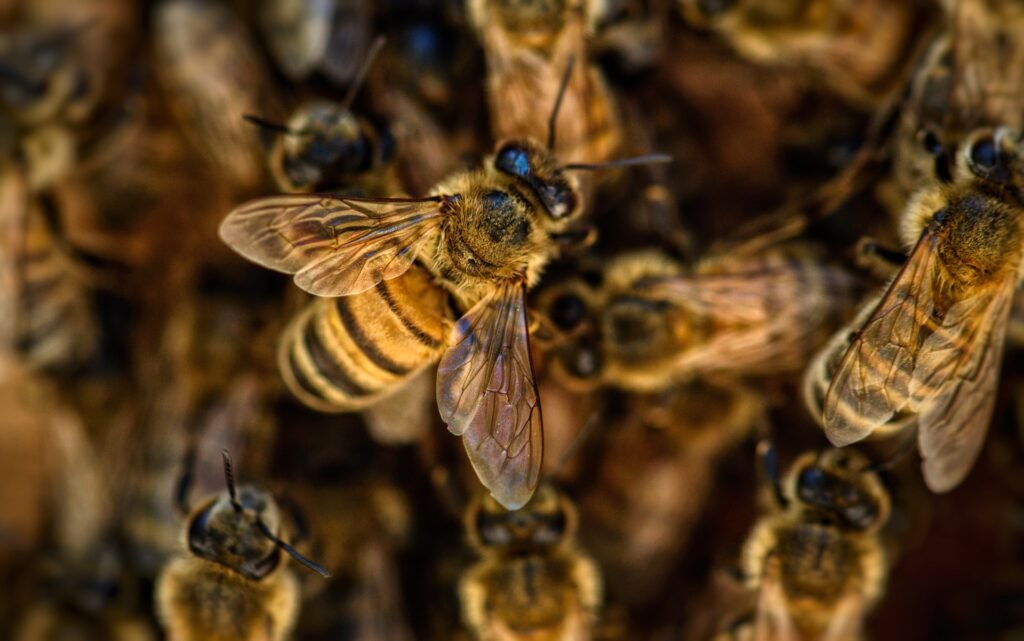
Following a waggle dance in the dark, crowded confines of a hive is no simple feat. How do bees extract meaningful information from the movements of one dancer in the bustle of dozens?
First, a follower bee must align herself with the dancer’s waggle run, matching orientation to detect the angle. She may tap or touch the dancer to sense direction and duration more precisely. Researchers have traced neuronal circuits that respond to vibration timing and antennal signals, illuminating how bees translate dance input into actionable navigation instructions. Axios+2PMC+2
In some recent neural mapping work, scientists identified three neuron types that register the start/stop timing of waggle oscillations and spatial orientation via antenna signals. Axios
But decoding is not purely mechanical: a bee’s prior experience matters. New dancers who had no opportunity to follow others initially produce less precise dances. That suggests that social learning refines the calibration of waggle communication over time. University of California+2labs.biology.ucsd.edu+2
In a study by James Nieh and colleagues, bees prevented from observing others before dancing themselves showed larger angle errors and less precise encoding—evidence that the dance language is partly learned. University of California+1
Thus, decoding involves more than raw encoding: it is a negotiated, socially calibrated communication.
Accuracy, Noise, and Environmental Effects
The waggle dance is impressively precise, but it is not perfect. Several factors introduce variability or “noise” in the system:
- Landscape and Optical Flow: The “distance” conveyed depends on how far the bee’s eyes perceive she’s flown—optical flow across the terrain. Open fields, dense vegetation, and landmarks can alter perceived distance and slightly distort the encoding. PMC+2ScienceDirect+2
- Sun Position Changes: Since the sun moves, the bee must compensate its dance angle over time. Some bees adjust their dance orientation mid-performance. American Museum of Natural History+2labs.biology.ucsd.edu+2
- Wind Drift and Navigation Adjustments: Right before departure, recruited bees may correct for wind drift, adjusting direction mid-flight. WIRED+2American Museum of Natural History+2
- Imprecision in Followers: Some followers may misinterpret the angle or duration due to crowding or poor alignment. Dances may average across multiple runs to reduce error. ScienceDirect+3ScienceDirect+3American Museum of Natural History+3
Despite noise, studies tracking bees via radar have validated that recruited bees often fly in the general direction and at roughly the expected distance. They then circle and use scent cues to refine their target. WIRED+2sussex.ac.uk+2
In a clever experiment, bees were displaced laterally before release—but still flew in the direction implied by the dance. That supports the interpretation that the dance, not just fragrance or path following, guides initial orientation. WIRED+2sussex.ac.uk+2
Collective Effects and Colony Efficiency
The waggle dance is not only about single pairs of bees: it scales into a collective strategy. When foragers communicate efficiently, colonies can concentrate effort on the most rewarding floral patches, minimizing wasted flight and maximizing yield.
In one study, manipulating dance orientation (rotating hives to disorient dances), colonies unable to communicate accurately foraged over longer distances and distributed effort more broadly—suggesting that dance precision helps reduce commuting costs. ScienceDirect
Other work shows that in a patchy landscape, the dance accelerates recruitment to rich patches, enhancing colony food collection. ScienceDirect+1
Moreover, recent research from Virginia Tech found that bees don’t all dance identically—some individuals have subtly different “styles” of waggle. That diversity increases the chance that at least some recruits interpret the dance successfully. news.vt.edu
In fact, the dance refinement, social learning, and individual variation all contribute to the robustness of communication across changing environments.
Emerging Discoveries: Genetics, Long Non-coding RNAs, and Culture
Most classic work on waggle dance centered on behavioral ecology and biomechanics. In recent years, molecular biology and genetics have added new dimensions.
One study compared brain RNA in dancing vs non-dancing bees, identifying long non-coding RNAs (lncRNAs) that differ between them. This suggests neural gene regulation underpins the propensity or capacity to perform dances. PMC
These lncRNAs are tied into pathways of signal transduction, stimulus response, and binding functions—indicating that internal neural states help modulate dance behavior. PMC
Other work focuses on how waggle culture may evolve. Because the dance language is partially learned, some scientists argue it has elements of cultural transmission across bee generations. University of California+2labs.biology.ucsd.edu+2
Further, computing and robotics researchers have automated dance decoding using computer vision and algorithms, opening paths to continuous monitoring of hive communications. arXiv
Why the Waggle Dance Still Fascinates
The waggle dance remains one of the most remarkable examples of animal communication. It encodes spatial information in a non-verbal, multimodal signal, is socially learned, and scales from individual pairs to colony-level strategies. Ongoing research continues to reveal deeper layers—neural, chemical, genetic, and computational.
In the broader tapestry of bee science, understanding the waggle dance is not just a curiosity. It has practical implications: for conservation of pollinators, design of pollinator gardens, modeling insect navigation, and even as inspiration for algorithms in robotics and network optimization.
The next time a beekeeper observes dancing bees in an observation hive, they are witnessing a coded performance of precision, adaptation, and cooperation—a language of motion that connects blossoms, hive, and bee in a single loop of life.